
PSE Meeting 2026 · Caserta and Campania
Attending the PSE Meeting 2026 is also an invitation to discover Campania: a region where royal architecture, medieval villages, ancient Greek and Roman sites, volcanic landscapes, coastal scenery and celebrated food traditions coexist within a remarkably compact area.
Caserta is an ideal base for exploring this heritage. Participants may wish to arrive a little earlier or remain after the conference to enjoy the city and the wider region at a more relaxed pace.
DISCOVER THE HOST CITY
Caserta: a Royal City
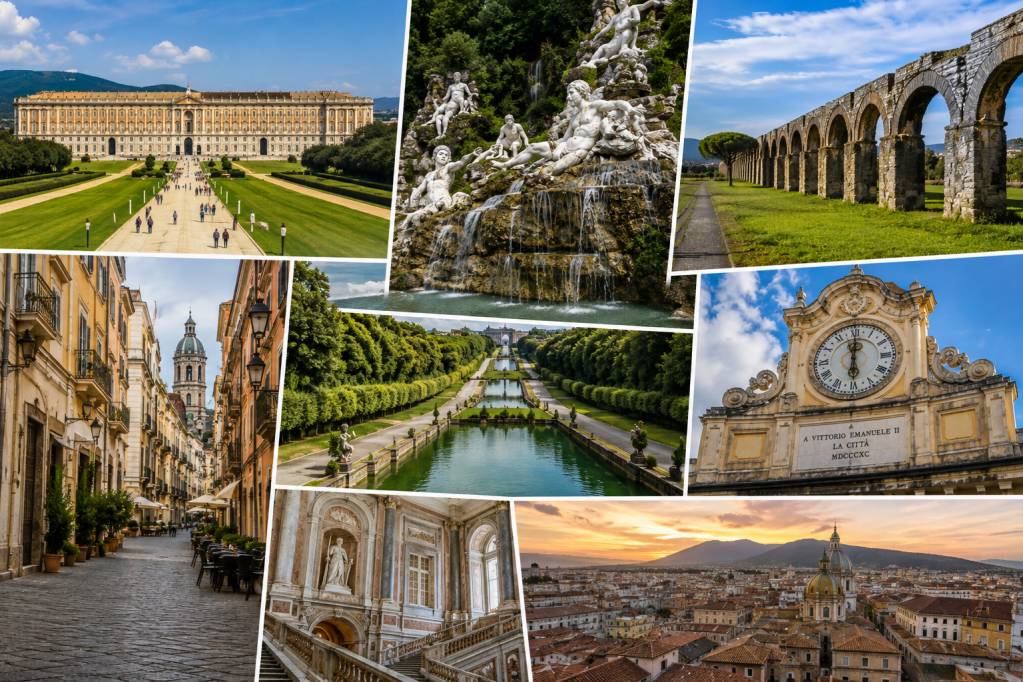
Modern Caserta developed around one of the most ambitious European building projects of the eighteenth century. In 1752, Charles of Bourbon laid the first stone of a new royal palace designed by Luigi Vanvitelli. The project was conceived not simply as a residence, but as the centre of a new inland capital for the Kingdom of Naples, combining royal representation, administration, gardens, water engineering and productive activity.
The resulting ensemble- the Royal Palace and Park, the Carolino Aqueduct and the San Leucio complex – was inscribed on the UNESCO World Heritage List in 1997. UNESCO highlights the way in which the site unites monumental architecture, landscape, infrastructure and Enlightenment-era social planning.
👑 The Royal Palace of Caserta
Designed by Luigi Vanvitelli for Charles of Bourbon, the Reggia di Caserta was conceived as the centre of a new royal capital and intended to rival the great royal courts of Versailles and Madrid. Its foundation stone was laid on 20 January 1752, the birthday of the King.
The scale of Vanvitelli’s project is extraordinary. The palace contains more than 1,200 rooms, arranged around four large internal courtyards, and combines monumental architecture with carefully designed perspectives connecting the building, the park and the surrounding landscape. Among its most impressive spaces are the spectacular Grand Staircase of Honour, the Palatine Chapel, the Royal Apartments and the Court Theatre.
The palace, however, is only one part of the experience. Behind it, the Royal Park extends for more than 120 hectares, structured around the spectacular three-kilometre Via d’Acqua. A sequence of monumental fountains, pools and cascades leads gradually uphill towards the Great Waterfall, creating the long perspective that can be seen directly through the central axis of the palace.
At the upper end of the park lies the English Garden, commissioned by Queen Maria Carolina in the late 18th century. One of the earliest English-style landscape gardens in continental Europe, it combines exotic and rare plants with lakes, streams, architectural ruins and carefully designed romantic landscapes.
Together with the Belvedere of San Leucio and the Carolino Aqueduct, the Royal Palace and its park have been included in the UNESCO World Heritage List since 1997, recognised as an exceptional expression of Enlightenment-era planning integrating architecture, landscape and industrial development.
→ Official website – Reggia di Caserta
Allow several hours for a complete visit. The Royal Apartments and the park require separate time, and comfortable shoes are strongly recommended.
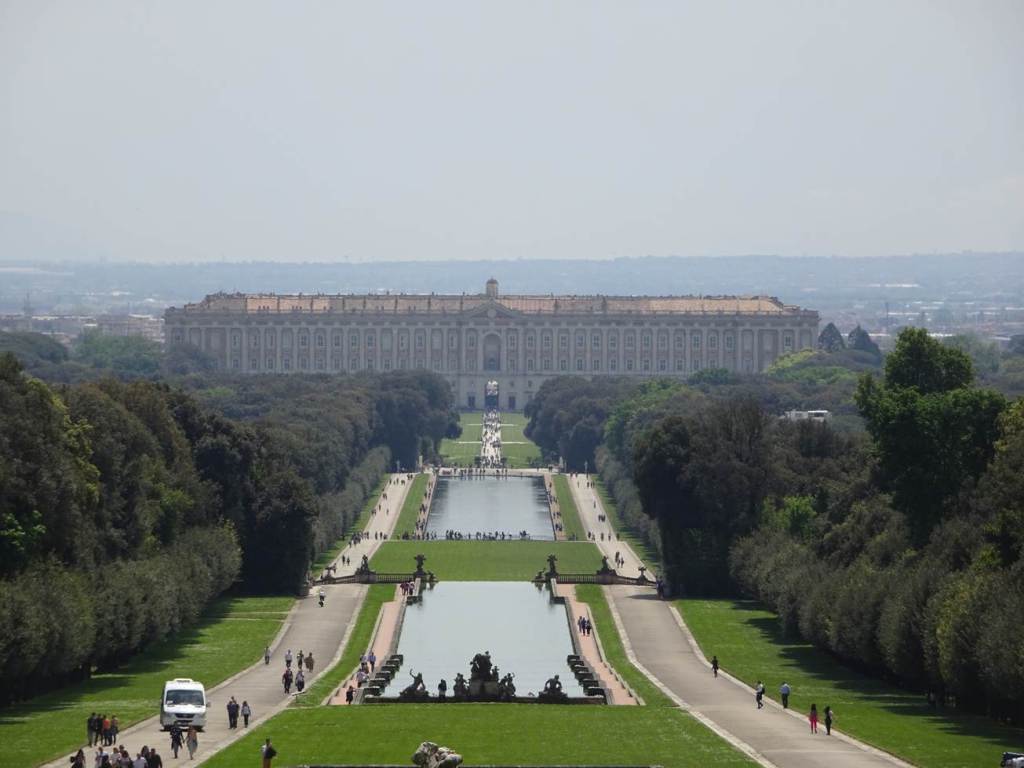
View of the palace along the central axis of the Royal Park.
San Leucio and the Carolino Aqueduct
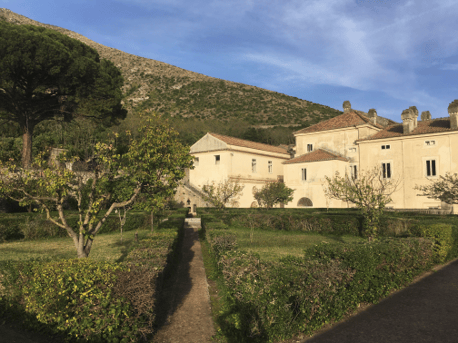
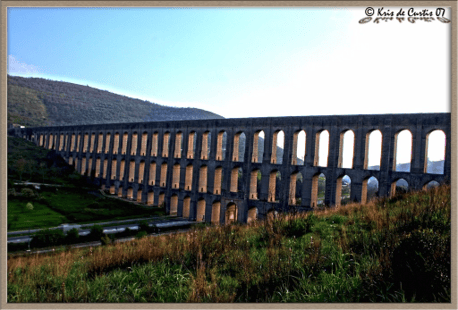
| Belvedere of San Leucio San Leucio grew from a royal hunting lodge into an innovative silk-producing community under Ferdinand IV. The complex is closely associated with the late-eighteenth-century vision of a planned society organised around work, education and welfare. Its historic looms, apartments and gardens preserve the memory of a textile tradition that made San Leucio silk internationally renowned. | Carolino Aqueduct Commissioned in 1753 and engineered by Luigi Vanvitelli, the aqueduct carried water over a route of roughly 38 kilometres to the royal estate. Its most spectacular surviving feature is the three-tiered Ponti della Valle at Maddaloni. The water system supplied the palace fountains and gardens and also supported the productive activities associated with San Leucio. |
Casertavecchia
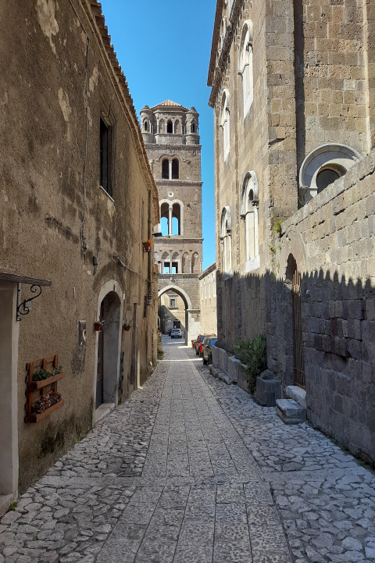
Long before the Bourbon palace reshaped the plain, the old settlement of Caserta occupied a defensible hilltop position. The name Caserta is traditionally believed to derive from the medieval Latin Casa Hirta, meaning “settlement on high ground”, a reference to the original town located on the nearby hills. Today, this beautifully preserved medieval village is known as Casertavecchia, literally “Old Caserta”. Casertavecchia preserves a medieval street pattern, stone houses, the remains of its castle and the Romanesque cathedral of San Michele Arcangelo, whose architecture reflects the cultural exchanges that characterised medieval southern Italy.
Today it is particularly attractive in the late afternoon and evening, when visitors can combine a walk through the village with panoramic views and dinner in one of its traditional restaurants.
Suggested time: half day or evening.
EASY EXTENSIONS BEFORE OR AFTER THE MEETING
Explore Campania
Caserta’s rail and motorway connections make it possible to reach several internationally renowned destinations. Travel times vary considerably with the chosen route, traffic and seasonal demand, so they should be treated as indicative only.
Naples
Founded by Greek settlers as Neapolis (“New City”) and shaped over more than 2,500 years by Roman, Byzantine, Norman, Angevin, Aragonese, Spanish and Bourbon rule, Naples is one of the oldest continuously inhabited cities in Europe. Its vast historic centre, a UNESCO World Heritage Site, preserves an extraordinary layering of history, art and architecture, while its spectacular setting on the Bay of Naples and its vibrant street life give the city its unmistakable character.
Naples is also inseparable from its food culture: pizza was born here, but the city’s culinary identity extends from street food and traditional pasta dishes to pastries such as sfogliatella and babà.
Some highlights not to miss
🏛️ National Archaeological Museum (MANN)
One of the world’s most important archaeological museums, particularly renowned for its exceptional collections from Pompeii and Herculaneum, as well as Greek and Roman antiquities.
→ Museo Archeologico Nazionale di Napoli
🎨 Cappella Sansevero and the Veiled Christ
In the heart of the historic centre, the Sansevero Chapel houses Giuseppe Sanmartino’s extraordinary Veiled Christ (Cristo Velato), one of the most celebrated sculptures in Naples.
⛪ The historic centre, Spaccanapoli and Via dei Tribunali
The best way to experience Naples is simply to walk through its historic centre. Spaccanapoli and Via dei Tribunali follow the ancient street plan of the Greek and Roman city and lead past churches, palaces, workshops, pizzerias and some of Naples’ most characteristic streets.
→ Historic Centre of Naples – UNESCO
⛪ Santa Chiara and Gesù Nuovo
Two of the landmarks of the historic centre stand only a few steps apart. The Gothic complex of Santa Chiara is particularly famous for its colourful majolica-tiled cloister, while the nearby Gesù Nuovo is immediately recognisable by its striking diamond-point façade.
→ Complesso Monumentale di Santa Chiara
👑 Piazza del Plebiscito and the Royal Palace
One of the city’s grandest monumental spaces, surrounded by the Royal Palace, the Basilica of San Francesco di Paola and, just nearby, the historic Teatro di San Carlo and Galleria Umberto I.
🏰 Naples’ castles and the seafront
From the medieval Castel Nuovo (Maschio Angioino) to Castel dell’Ovo, overlooking the Bay of Naples, the city’s castles reflect different periods of its long history. A walk along the seafront from Castel dell’Ovo towards Chiaia is also one of the best ways to enjoy views of the bay and Mount Vesuvius.
🌅 Vomero, Castel Sant’Elmo and the Certosa di San Martino
For one of the most spectacular views over Naples, the bay and Vesuvius, take the funicular up to the Vomero district and visit Castel Sant’Elmo and the nearby Certosa di San Martino.
→ Discover what to see in Naples
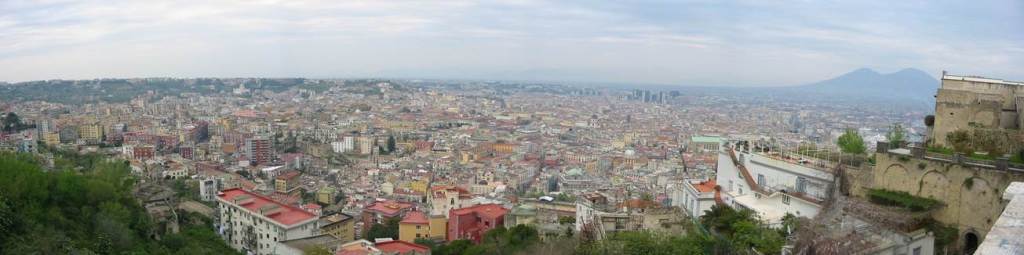
Naples, with Mount Vesuvius visible across the bay.
🌋Pompeii and Vesuvius
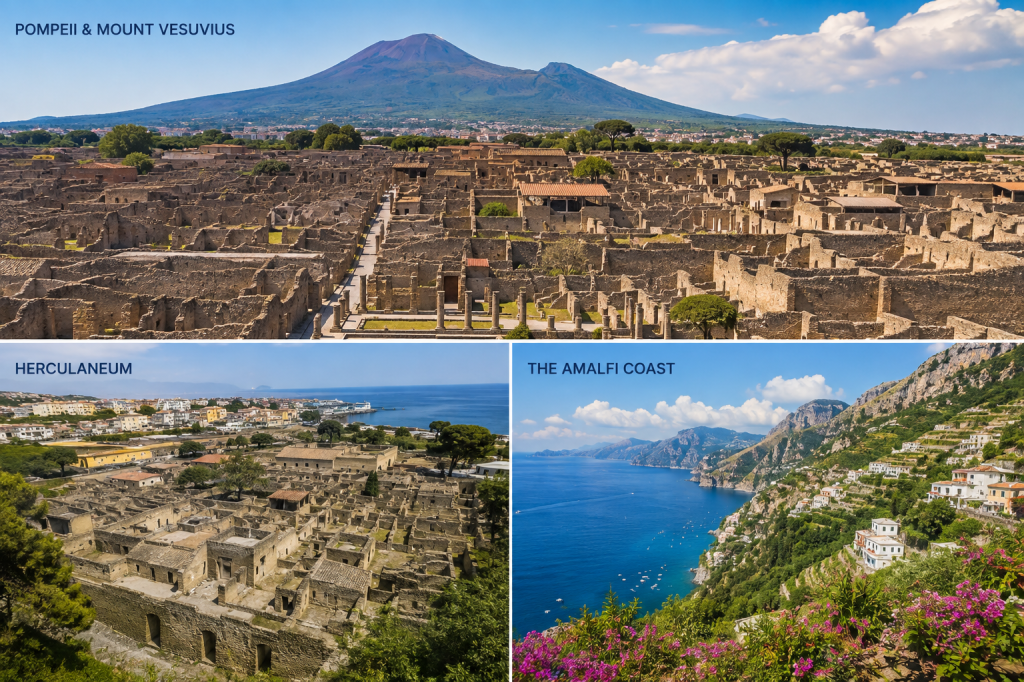
Few places illustrate the relationship between history and landscape as dramatically as Pompeii and Mount Vesuvius. The ancient Roman city was buried by the eruption of Vesuvius in AD 79, when volcanic ash and lapilli covered streets, houses, shops, baths, temples and public buildings. Paradoxically, the catastrophe also preserved an extraordinary record of Roman urban life, from monumental architecture and elaborate frescoes to gardens, shops, inscriptions and objects of everyday use.
Rediscovered and systematically excavated from the 18th century onwards, Pompeii is today one of the world’s most important archaeological sites and, together with Herculaneum and Torre Annunziata, has been included in the UNESCO World Heritage List since 1997. The scale of the site is remarkable: Pompeii was a living city, not a single monument, and walking through its streets provides an exceptional sense of its original urban fabric.
Rising above the archaeological site is Mount Vesuvius, one of the most famous volcanoes in the world and the dominant feature of the landscape of the Bay of Naples. The volcano and its surroundings are protected within the Vesuvius National Park, and visitors can reach the upper part of the volcano and walk towards the crater rim for panoramic views over the Bay of Naples and the surrounding region.
Allow several hours for Pompeii alone. The archaeological area is extensive, so comfortable shoes, sun protection and water are strongly recommended. A guided visit or a carefully planned route will help you make the most of your time. You can also take advantage of the tour offered within the PSE meeting experience.
→ Official website – Archaeological Park of Pompeii
→ Official website – Vesuvius National Park
🏛️ Herculaneum
Often overshadowed by nearby Pompeii, Herculaneum (Ercolano) offers a different and remarkably intimate glimpse into life in an ancient Roman town. Like Pompeii, it was destroyed by the eruption of Mount Vesuvius in AD 79, but the two cities were buried in very different ways.
While Pompeii was largely covered by ash and lapilli, Herculaneum was engulfed by extremely hot volcanic flows that buried the town beneath a deep layer of volcanic material. These exceptional conditions preserved elements rarely surviving at ancient sites, including wooden structures, doors, furniture, food remains and even upper floors of buildings, alongside mosaics and vividly coloured wall paintings.
Herculaneum is considerably smaller than Pompeii and can generally be explored in a few hours. Its compact size and exceptional state of preservation make it an excellent alternative — or complement — to a visit to Pompeii.
→ Official website – Archaeological Park of Herculaneum
🌊 The Amalfi Coast
Stretching along the southern side of the Sorrento Peninsula, the Amalfi Coast (Costiera Amalfitana) is one of Italy’s most celebrated landscapes. Here, steep mountains descend dramatically towards the Mediterranean, with villages, terraces, gardens and vineyards occupying seemingly impossible spaces between the cliffs and the sea.
The coast has been shaped over centuries by the interaction between its inhabitants and this challenging landscape. Terraced cultivation particularly of the characteristic Amalfi lemon, vineyards, historic paths and small settlements form a cultural landscape that has been recognised as a UNESCO World Heritage Site since 1997.
Among its best-known towns is Amalfi, once the centre of a powerful medieval Maritime Republic and home to the striking Cathedral of Sant’Andrea. Nearby Ravello, perched high above the coast, is famous for its gardens and extraordinary views, particularly those from Villa Rufolo and Villa Cimbrone. Positano, with its colourful houses descending towards the sea, has become one of the most iconic images of the Mediterranean.
The experience, however, is as much about the journey as the individual destinations: winding coastal roads, boats connecting the towns, historic footpaths and constantly changing views are all part of the character of the Costiera.
Plan your visit carefully. Distances on a map can be deceptive: the coastal road is narrow and traffic can be heavy, particularly during the tourist season. Whenever possible, ferries are an excellent way to travel between the main coastal towns, while also offering spectacular views from the sea.
→ Amalfi Coast – UNESCO World Heritage Centre
→ Travelmar – Ferry connections along the Amalfi Coast
Taste Campania
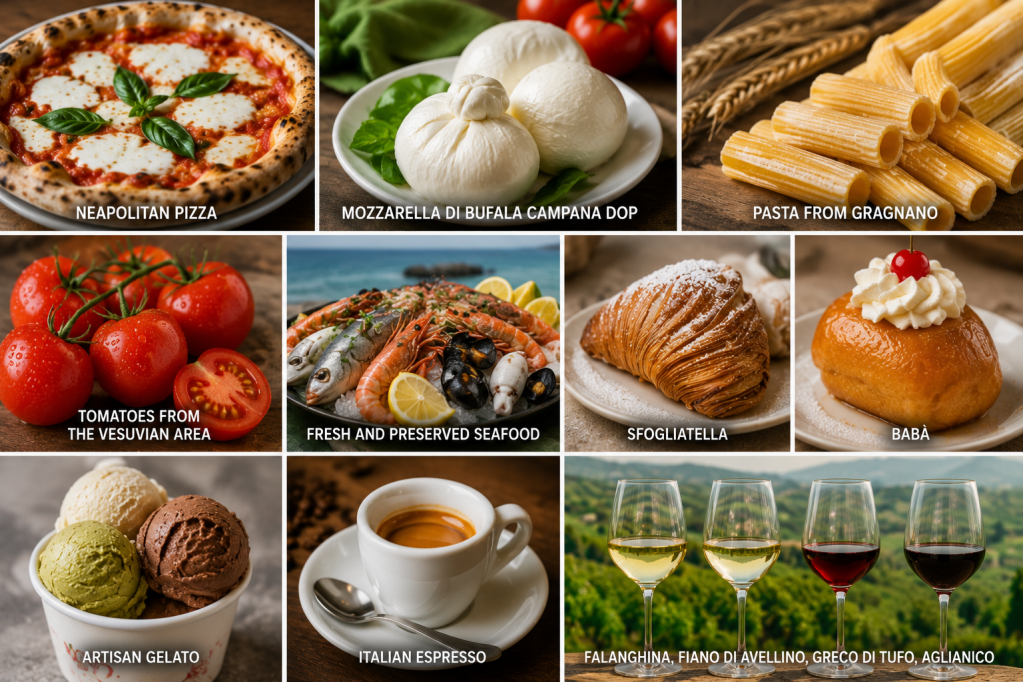
Campania’s food traditions are shaped by fertile volcanic soils, coastal resources and centuries of exchange. Neapolitan pizza is only the best-known example. Other specialties include Mozzarella di Bufala Campana DOP, pasta from Gragnano, tomatoes grown in the Vesuvian area, fresh and preserved seafood, seasonal vegetables, pastries such as sfogliatella and babà, artisan gelato and the concentrated ritual of Italian espresso.
Regional wines include Falanghina, Fiano di Avellino, Greco di Tufo and Aglianico. Around Caserta, participants may also encounter local products and dishes that are less familiar internationally but deeply rooted in the territory.
Planning Your Visit
- Check official opening days and times before travelling; museums and archaeological sites may close on particular weekdays or alter access arrangements.
- Book major attractions and ferries in advance when possible, especially for Pompeii, Capri and the Amalfi Coast.
- Wear comfortable shoes: historic centres, archaeological areas and the Royal Park involve substantial walking and uneven surfaces.
- Do not rely on a single travel-time estimate. Traffic, ferry conditions and public-transport timetables can change.
- For current practical information, consult the official websites of the attractions and local transport providers.
🇮🇹 The Phytochemist’s Survival Guide to Italy
Welcome to Italy!
No real survival skills are required, but a little preparation might help. Before joining us in Caserta, we invite you to have a look at our Phytochemist’s Survival Guide to Italy: a light-hearted collection of tips, cultural quirks and useful hints to help you navigate Italian everyday life.
Have a look, take notes if you wish, and come prepared to enjoy the full Italian experience!

